Best Thermometers for Fermentation in 2026
Last updated July 22, 2026
Temperature governs almost everything in fermentation. Too cold and your cultures go dormant. Too hot and you kill them. Whether you're brewing kombucha, making kimchi, culturing yogurt, or homebrewing beer, knowing your exact temperature is the difference between a successful batch and a spoiled one. A good thermometer pays for itself on the first batch it saves. Here are the best options for home fermenters at every budget.
The Ferment Guide is reader-supported. When you buy through links on this page we may earn an affiliate commission, at no extra cost to you. We only recommend gear we'd use ourselves. Learn more.
TempPro TempSwift Digital Instant-Read Thermometer
Our Top Picks
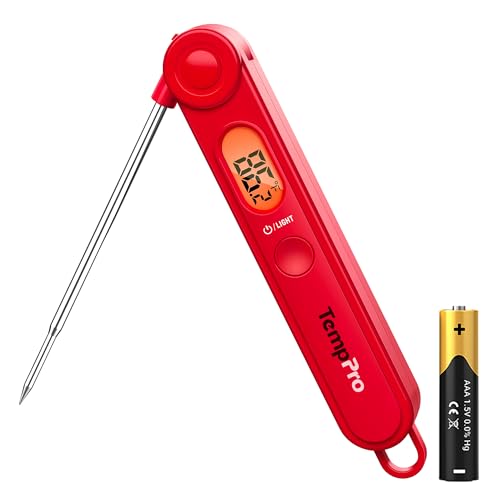
1. TempPro TempSwift Digital Instant-Read Thermometer
What we like
- One-second readout with ±0.9°F accuracy
- Folds flat for storage — button releases the probe
- Large, backlit display is easy to read in dim spaces
- Under $10 — exceptional value
Watch out for
- No Bluetooth or logging — manual readings only
- Sold as a meat thermometer, so the marketing is all about grilling
Our verdict: The cheap instant-read is the thermometer home fermenters reach for most, and this one costs less than a bag of salt. A one-second reading to within a degree is far more precision than checking brine temperature, testing dough, or monitoring a kombucha vessel actually requires. Buy it, keep it in the drawer, and stop guessing.

2. Lavatools Javelin PT12 Instant Read Thermometer
What we like
- 2–3 second read time with ±0.9°F accuracy
- Ambidextrous display rotates 180° for easy reading
- Sleek, durable build with antimicrobial coating on probe
- IP65 splash-resistant — survives kitchen spills
- Auto-off after 10 minutes saves battery
Watch out for
- Costs more than the TempPro TempSwift — harder to justify for casual use
- Probe is slightly shorter than some competitors
Our verdict: The Javelin PT12 is a step up in build quality and speed. The rotating display is genuinely useful when you're reaching into a tall jar or fermenting vessel at an awkward angle. If you ferment frequently and want a thermometer that feels premium, this is the one to reach for.

3. OXO Good Grips Thermocouple Thermometer
What we like
- Thermocouple sensor reads in under 2 seconds
- Long, thin probe reaches deep into carboys and pots
- Water-resistant — holds up to repeated rinsing
- Clear display with backlight and easy hold button
- OXO's reliability and warranty make it a long-term investment
Watch out for
- The most expensive pick here — a premium, pro-grade tool
- Slightly bulkier to store than folding models
Our verdict: OXO makes equipment that lasts, and this thermocouple thermometer is no exception. The speed and long probe make it ideal for homebrewing — checking mash temps, pitching temps, and wort cooling — as well as cheesemaking, where you're frequently stirring and monitoring a large pot of milk.

4. Taylor Precision Products 9848 Instant Read Thermometer
What we like
- One of the most affordable accurate thermometers available
- Simple single-button operation — no learning curve
- 5-inch probe reaches into jars and vessels without issue
- Reads to ±2°F — adequate for most fermentation use
- Widely available at grocery stores and online
Watch out for
- Slower read time (5–7 seconds) than pricier models
- No backlight or foldable probe
- Accuracy is ±2°F rather than ±1°F
Our verdict: If you're just starting out and want to spend as little as possible, the Taylor 9848 gets the job done. It won't win speed records and the accuracy is slightly looser than premium models, but for checking ambient-temperature brine or yogurt incubation warmth, it works reliably.

5. Etekcity Lasergrip 1080 Infrared Thermometer
What we like
- Instant, no-contact surface temperature reading
- Great for checking the outside of fermentation vessels
- Wide temperature range: -58°F to 1,022°F
- Useful beyond fermentation — baking stone, stovetop, fridge temperature
Watch out for
- Reads surface temperature only — not liquid temperature inside a jar
- Less accurate than a probe for fermentation purposes
- Not a replacement for a probe thermometer in most scenarios
Our verdict: An infrared thermometer is a handy complement to a probe model, not a replacement. It's useful for quickly checking the surface of a warm yogurt incubator, a proofing box, or a fermentation chamber without opening the lid. But if you only own one thermometer, make it a probe. This works best as your second tool.
What to Look for in a Fermentation Thermometer
Instant-read vs. analog vs. infrared
Instant-read probe thermometers give a precise digital readout in 2–3 seconds and work for any ferment — liquids, doughs, or solids. Analog dial thermometers are slower but require no batteries and never need calibrating. Infrared thermometers read surface temperature without contact, which is useful for quick checks but less accurate for liquids deeper in a jar.
Temperature range
Most fermentation happens between 60°F and 110°F (15°C–43°C). Look for a thermometer that covers at least this range comfortably. If you homebrew and need to check mash temperatures (up to 170°F / 77°C), make sure your thermometer reaches there too.
Accuracy
For fermentation, ±1°F accuracy is more than adequate. For bread baking or cheesemaking where a few degrees matter, look for ±0.5°F or better. Most quality digital instant-read thermometers in the $15–$40 range hit ±1°F without issue.
Ease of cleaning
Fermentation involves live cultures — cross-contamination is a real risk. Choose a thermometer with a stainless steel probe that's easy to wipe down with isopropyl alcohol or rinse under hot water. Avoid models with difficult-to-clean crevices around the display.
Frequently Asked Questions
Related Guides
Fermentation for Beginners
Everything you need to know to start fermenting at home. What it is, how it works, what you need, and which projects to try first.
🍺Homebrewing Beer
Your first batch of homebrew — from extract kit to bottled beer. Simpler than you think, endlessly rewarding.
🥄Homemade Yogurt
Thick, creamy yogurt from scratch with just milk and a spoonful of starter. No special equipment needed.
Shop Related Equipment
Our top-rated gear picks for this project.
Best pH Meters for Fermentation in 2026
A pH meter takes the guesswork out of fermentation safety. We tested the top options for home fermenters — from budget pen meters to lab-grade accuracy — to find the best pick for your setup.
Best Temperature Controllers for Fermentation in 2026
Temperature is one of the biggest variables in fermentation — and a temperature controller lets you dial it in precisely. We reviewed the top options for home fermenters and homebrewers.
Best Fermentation Heating Mats in 2026
Keep your ferments at the right temperature year-round. We compared the top heating mats for kombucha, sourdough, yogurt, kefir, and tempeh — from budget seedling mats to WiFi-controlled options.
The Ferment Guide is reader-supported. When you buy through links on this page, we may earn a small affiliate commission. This doesn't affect our recommendations — we only feature products we genuinely use and trust.