What Are Fermented Pickles?
Here's the thing most people don't realize: the pickles you grew up eating from the grocery store aren't fermented. They're cucumbers soaked in vinegar. They're sour because of the vinegar, not because of any biological process. They're dead on arrival — no probiotics, no live cultures, no gut benefit.
Lacto-fermented pickles are the real deal. You submerge cucumbers in a salt brine, and the naturally occurring lactobacillus bacteria on the cucumber skins get to work, converting sugars into lactic acid. It's the same process that turns cabbage into sauerkraut or napa cabbage into kimchi. That lactic acid is what makes them sour, tangy, and complex — and it's also what preserves them. This is the way pickles were made for thousands of years before vinegar became the shortcut.
The result? A pickle that's alive with beneficial bacteria, has a flavor depth that vinegar pickles can't touch, and still has that satisfying crunch. Once you've had a real fermented pickle, the store-bought ones taste flat.
💡 The brine ratio
Unlike sauerkraut and kimchi where the vegetables create their own liquid, pickles use a pre-made salt brine. The standard ratio is about 3–5% salt by weight of water. That's roughly 2 tablespoons of salt per quart (4 cups) of water. This creates the perfect environment for lactobacillus to thrive while keeping spoilage bacteria out. Too little salt and things go south; too much and fermentation stalls.
The Process
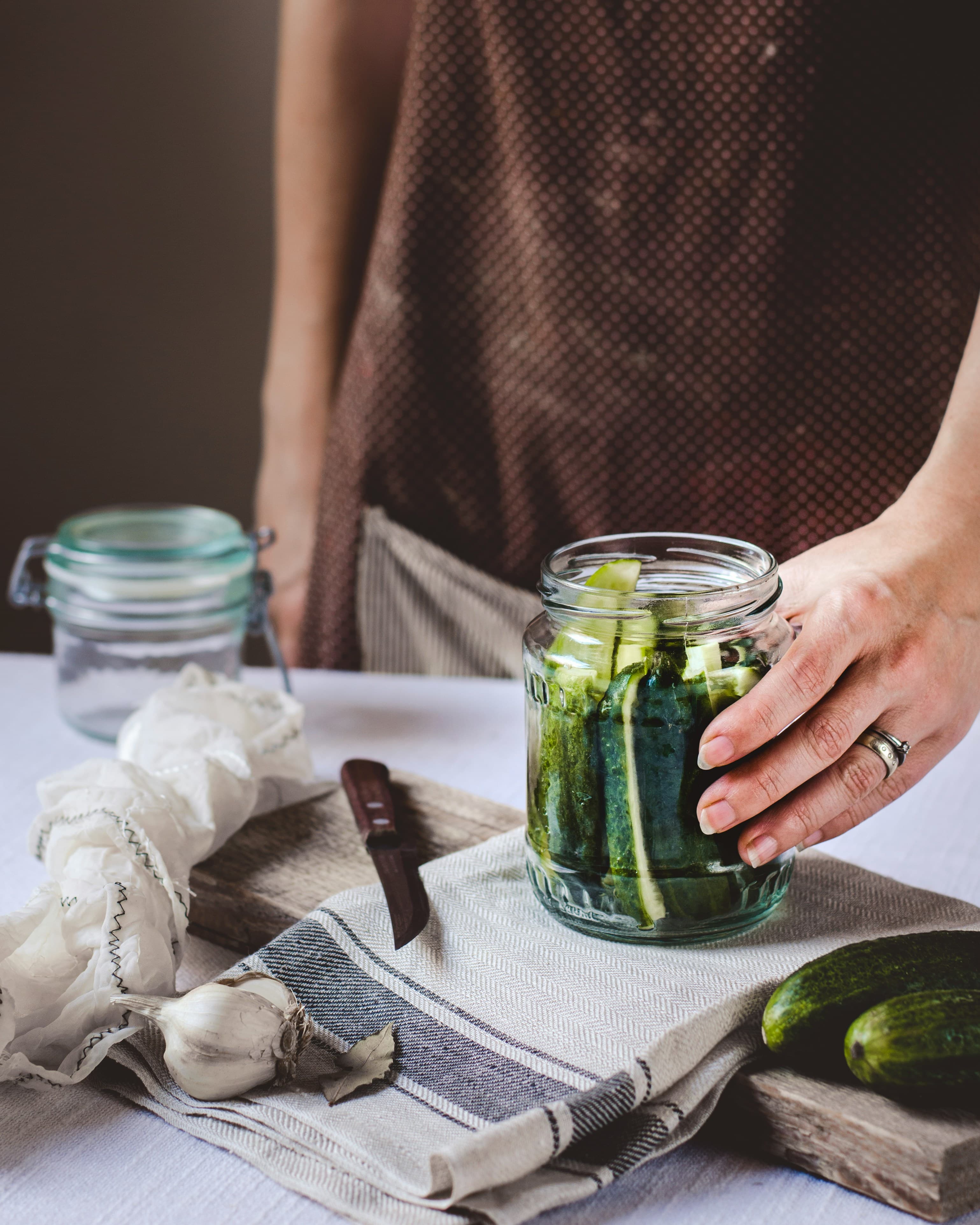
Prep the cucumbers. Wash the cucumbers well and trim off the blossom end (the end opposite the stem). This is important — the blossom end contains an enzyme that softens pickles. You don't need to peel them. If your cukes are too long for the jar, cut them in half lengthwise or into spears. Smaller cucumbers can go in whole.
Make the brine. Dissolve 2 tablespoons of sea salt in 4 cups of filtered water. Stir until fully dissolved. That's it. No vinegar, no sugar, no heat required. If you want to be precise, use a kitchen scale and aim for 3.5% salt by weight of water (about 35g per liter).
Layer the jar. Drop the garlic, dill, peppercorns, and any other spices into the bottom of a clean mason jar. Pack the cucumbers in tightly — vertical is usually best for whole pickles and spears. You want them wedged in so they don't float. If you have grape leaves or oak leaves, tuck one on top of the cucumbers before adding the brine.
Pour in the brine. Pour the salt brine over the cucumbers until they're fully submerged. Leave about an inch of headspace at the top. The cucumbers must stay below the brine at all times — anything poking above the surface can develop mold. Place a fermentation weight on top to hold everything down.
Cover and ferment. Close the jar with a loose lid, a cloth secured with a rubber band, or an airlock lid. Place the jar on a plate or in a bowl (brine can overflow once fermentation gets going) in a cool spot out of direct sunlight. Ideal temperature is 65–75°F (18–24°C).
Wait and taste. You'll see bubbles within the first day or two — that's the lactic acid bacteria doing their thing. The brine will get cloudy. This is completely normal and actually a sign of a healthy ferment. If using a regular lid, burp the jar daily. Start tasting after 3 days. At this point, you'll have a “half sour” — still bright green with a mild tang and crunch. At 5–7 days, you'll have a “full sour” — more olive-green in color, deeply tangy, and still crunchy.
Refrigerate. When the pickles taste right to you, move the whole jar to the fridge. The cold dramatically slows fermentation, locking in the flavor and crunch. They'll continue to slowly develop but at a glacial pace.
Garlic Dill Fermented Pickles
The classic combination. Use the same base recipe above, but go heavy on both garlic and dill for a pickle that tastes like it came from a New York deli counter. Here's what to change:
- Garlic — increase to 8–10 large cloves, peeled and smashed
- Dill — use 3–4 large dill heads with plenty of fronds; or 2 tbsp dried dill seed for a sharper dill hit
- Optional — add 1 tbsp whole black peppercorns and 1/4 tsp red pepper flakes for depth
Layer half the garlic and dill on the bottom, pack the cucumbers tightly, then tuck the remaining garlic and dill along the sides and on top before adding brine. This ensures the aromatics infuse from all directions. The result is a deeply garlicky, herbaceous fermented pickle that's nearly impossible to stop eating.
For spicy fermented pickles, add 2–3 sliced fresh jalapeños to the jar along with the garlic and dill. The heat mellows slightly during fermentation but stays lively. This is the same method as the base recipe — just a bolder variation.
Half Sour vs. Full Sour
This isn't just deli jargon — it describes two genuinely different pickles. Half sours have been fermenting for 3–4 days. They're still bright green, very crunchy, and mildly tangy with a fresh cucumber flavor underneath. Full sours have gone 5–7+ days. They're olive-green throughout, deeply sour, and have that unmistakable funky, complex fermented flavor. Both are fantastic — it's a matter of personal preference. The beauty of fermenting at home is you pull them when they're exactly where you want them.
🥒 Cucumber selection matters
Use small, firm pickling cucumbers (Kirby, gherkin, or Persian varieties). Regular slicing cucumbers from the grocery store are bred for salads, not pickles — they have more water, thinner skins, and will turn to mush. If you can't find pickling cukes, Persian (mini) cucumbers are your best backup. And always use the freshest cucumbers you can find — the fresher they are, the crunchier your pickles will be.
🍃 The grape leaf trick
Tucking a grape leaf, oak leaf, horseradish leaf, or even a bay leaf on top of your pickles helps them stay crunchy. These leaves contain tannins that inhibit pectinase — the enzyme that breaks down pectin and causes softening. It's an old-school technique that genuinely works. If you don't have access to fresh leaves, a pinch of black tea leaves does the same thing.
Troubleshooting
For more detailed guidance on common vegetable fermentation problems, see our vegetable fermentation troubleshooting guide.
The pickles are soft or mushy
This is the number one complaint with fermented pickles, and it usually comes down to one of three things: you used slicing cucumbers instead of pickling cucumbers, you didn't trim the blossom end, or you fermented too long or at too high a temperature. Keep the temperature under 75°F (24°C) if you can — heat speeds up fermentation and breaks down the pectin faster. Adding a grape leaf or tannin source (as mentioned above) also helps. For next time, use the smallest, firmest cukes you can find and start tasting early.
The brine is cloudy
Good news — this is totally normal. Cloudy brine means the lactobacillus bacteria are active and producing lactic acid. That's the whole point. Clear brine in a supposedly fermented pickle is actually the suspicious one. Embrace the cloud.
White film on the surface
That's kahm yeast — harmless but annoying. Skim it off and make sure everything stays submerged under the brine. A fermentation weight and airlock lid together nearly eliminate this problem. If you see fuzzy, colored mold (green, black, pink), discard the batch. This is rare if the cucumbers stay submerged and you used the right salt ratio.
The pickles taste too salty
Your salt concentration may be too high. Next time, try a slightly lower ratio — closer to 3% rather than 5%. You can also ferment a bit longer, as the bacteria convert more of the brine's character over time and the sourness starts to balance out the salt. In the meantime, the salty pickles are still great chopped into relish, tuna salad, or potato salad where the extra salt works in your favor.
Nothing is happening — no bubbles
If your kitchen is cool (below 65°F / 18°C), fermentation can be slow to start. Give it another day or two. If nothing happens after 4 days, your water might contain chlorine or chloramine that's killing the bacteria. Switch to filtered water or let tap water sit out uncovered for 24 hours before using. Also make sure your salt is non-iodized — iodine is antibacterial and can stall fermentation.
Storage and Shelf Life
Once refrigerated, fermented pickles keep for 2–3 months easily, and often much longer. The lactic acid acts as a natural preservative. The flavor will continue to slowly develop in the fridge — they'll get more sour over time, which most people consider a plus.
Always keep the pickles submerged in brine, even in the fridge. If the brine level drops (you keep sipping it — we get it), top it off with a fresh 3% salt solution.
What to Do With Them
- Eat them straight from the jar — the classic move
- Chop into relish for hot dogs, burgers, and sandwiches
- Slice onto a charcuterie board with cheese, salami, and crackers
- Dice them into potato salad or egg salad
- Batter and deep fry for fermented fried pickles (yes, really)
- Serve alongside smoked meats and BBQ — the acidity cuts through the richness
- Drink the brine as a probiotic gut shot or use it as a base for salad dressings and marinades
🫙 Save the brine
Pickle brine is incredibly versatile. Use it as a probiotic gut shot (some people swear by it for hangovers), as a marinade for chicken, as a salad dressing base, or pour it over fresh vegetables to quick-ferment them. You can also use a splash of leftover brine to jumpstart your next batch of pickles — the live cultures give the new batch a head start.
📈 Level up
Once you've nailed the classic dill pickle, experiment with flavor variations. Try adding fresh jalapeño slices for spicy pickles, swap dill for fresh tarragon, add a cinnamon stick and cloves for a warm-spiced pickle, or go full Eastern European with lots of garlic, dill, and horseradish. You can also ferment other vegetables in the same brine — green beans, carrots, cauliflower, and radishes all work brilliantly.